
Reporting and Writing
Photo by Betty Jane Plitt
I enjoy writing stories about topics I have little to no knowledge about. Each experience while reporting teaches me not only something new about the subject but something new about myself and how I want to continue as a journalist.
With writing, I strive to find a unique, in-depth pitch that reveals multiple layers, whether that involves tracking down multiple sources, blind-calling businesses, or driving to a place late at night for a single photo. The challenge of uncovering an amazing story is what excites me the most about journalism.
News

This was the first in-depth story I ever wrote, and it took five months of research and scheduling interviews. The story highlights the costs and importance of safety for teenagers using golf carts in my hometown, Peachtree City. The town has over one hundred multi-use paths, and most students walk or ride them to school. The story ultimately won the first "Best of SNO" award for the McIntosh Trail.

This story pushed me to grow as a journalist. I ended up developing this story over a span of four months because my local Walmart had to be completely shut down for renovation. For me, it was more than breaking news; it was a chance for me to cover an important issue that affected everyone around me.

It all started in the senior group chat when a couple of seniors couldn't decide on a football game theme. Our student section leaders announced that the theme was "white-out," although some seniors didn't agree with this theme and preferred "neon." This debate confused underclassmen, and in the end, everyone ended up wearing what they preferred to the game, and the image was the result.
Features

I found this story by just talking to people. One of my friends in my class told me about how she and her friends started an indie band called "The Id." These students came from our high school's band and orchestra programs and used one of the members' basements to write and produce their own music. I was able to sit down with all the members for an interview that lasted over an hour while they explained how the band came to be and what their goals were for the future.

I only knew about the Junk Kouture contest because a Trail writer had written about a McIntosh student winning in 2023. So, when I heard that seniors Cianna Ricci and Chloe Davis had competed in Monaco, I immediately took the pitch. The duo won New York Designer of the Year for their sustainable piece titled ”Mother of Poison," inspired by the superhero, Poison Ivy. The concept and its creation, made from all recycled materials, promote environmental awareness and the impact of student designers.

I had heard about this opportunity from my adviser and Editor-in-Chief, who had been involved with the program the year before. Working with New Voices during my sophomore year was so inspiring, and I believe it was a crucial experience that made me the journalist I am today. Learning about the role of SPLC in the world of student journalists encouraged me to learn more about censorship and the struggles states without New Voices bills face.
sports

I got this idea from seeing all of the seniors at my school committing to a variety of schools with different academic and athletic expectations. It made me wonder what factors athletes have to consider when balancing lots of offers from very different college programs.

This was coverage I got from one of the first cross country meets of the season this year, with one of the runners setting a new record. This year, one of the main goals for the Trail was getting better sports coverage, and everyone was assigned a sport to cover in some way; this was mine.

This feature was another contribution to our increased sports coverage this year. Logan Palmer was the senior captain of the Varsity cross country team. He started cross country recovering from an injury while playing soccer. He started running because of the physical therapy he had to do for his dislocated knee, and eventually fell in love with running.
opinion

I have been a fan of Swift's for years. I actually followed the announcement of her Eras tour and covered the Ticketmaster "war." When I heard that she was announcing a brand new album aside from her "Taylor’s Version" albums that she had been releasing, I had some thoughts about it.

I grew up watching "Stranger Things" like most of my generation has, and the ending I felt was just bad. It left me, as a viewer, with so many questions unanswered, as well as the rush of concepts at the very end of the final season.

Graphic by Canva
I got this idea from seeing all of the seniors at my school committing to a variety of schools with different academic and athletic expectations. It made me wonder what factors athletes have to consider when balancing lots of offers from very different college programs.
Reporting
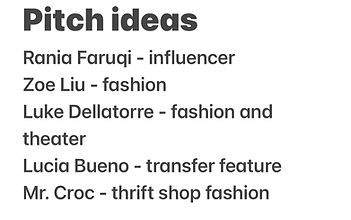
1. Finding a Pitch
I enjoy staying organized when I start a new pitch. I immediately create a Google Doc and divide it into sections. Usually, these include Headline, Subheadline, interview questions, and research links. There is always something going on in the world, but I make it a priority to find a story on my high school campus that no one knows about. For instance, last year, I wrote a story of a student who travelled across the world for Junk Kouture and won in the US. Stories like these inspire me to talk to students at my school and learn about what interests them. Everyone has a story just waiting to be told.



2. Interview questions
Whenever I’m crafting my interview questions, I always consider the 5 W’s. Who, what, when, where, and why? asking these questions helps me craft a lead and identify the main points of my story. I like to carefully choose who I’m interviewing to see who would work best for the story I’m telling and to make sure I’m getting as much information and opinions as I can. For example, for my story about golf cart accidents, I chose students who were involved in accidents, but I also interviewed an insurance agent who was familiar with golf cart accidents and their costs.

3. Dividing sections
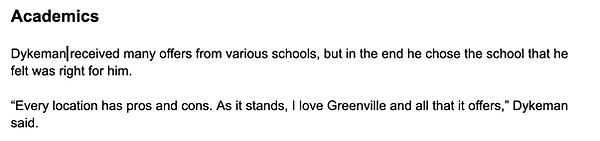
When I'm writing a story, especially one that's in-depth, I like to divide it into sections. For example, when I wrote about athletic and academic decisions for college-bound athletes, I divided the entire story into sections. Some included team culture, Financial Aid and Scholarships, and academics. All were key things an athlete had to consider when deciding where to commit. I feel that doing this not only makes it so much simpler for the writer but much more readable for the viewer.



4. Background research
Deciding which sources can be hard in this age because of the possibility of biased and unreliable sources. My advisor has recommended NPR to our staff, but I also like to look at AP news. When researching, I make it a priority to remain completely unbiased, unless it's an opinion.